
Bathroom and Kitchen Surfaces in Roman Travertine Stone
Roman travertine stone for bathroom and kitchen surfaces, countertops and integrated interior architecture.

Bathroom and kitchen surfaces represent one of the most refined interior applications of Roman travertine stone, where the material defines not only horizontal planes such as countertops and washbasins, but also vertical surfaces and integrated architectural elements. In these environments, travertine is used not as a decorative finish, but as a structural and compositional material that contributes to the identity of the space.
Roman travertine stone is particularly suitable for interior surfaces because of its balance between visual warmth and material consistency. Its natural porosity, tonal variation and layered structure create surfaces that are visually rich without becoming excessive, allowing the material to adapt to both contemporary and more traditional interior architectures. This adaptability makes it effective in spaces where design continuity and tactile quality are essential.
Because bathroom and kitchen surfaces are experienced at close range, the selection of finish, cut and integration with other elements becomes crucial. Roman travertine allows these surfaces to be part of a unified architectural system, connecting floors, walls and built components into a coherent material language. This page explores how travertine is used in interior surfaces, how it behaves in different configurations and how it contributes to the spatial definition of bathrooms and kitch
Travertine Surfaces in Interior Architecture
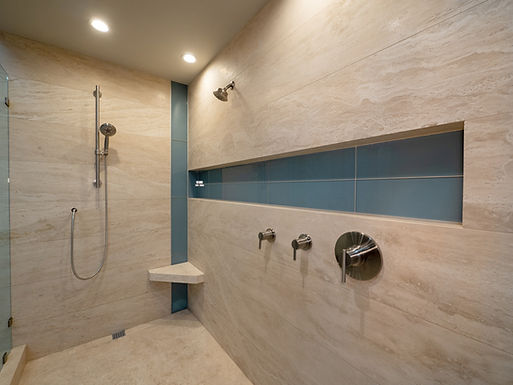
Material continuity across surfaces
Travertine surfaces in interior architecture are defined by their ability to create continuity across different planes. In bathrooms and kitchens, Roman travertine stone can be used for countertops, walls and built elements, allowing the space to be perceived as a cohesive whole rather than a combination of separate materials. This continuity is particularly important in contemporary design, where the reduction of material variation enhances spatial clarity and visual balance.
From surface to architectural element
Unlike materials that function purely as finishes, Roman travertine surfaces can become integral architectural elements. Washbasins, counters and vertical panels can all be conceived as extensions of the same material logic. This transforms the perception of the space, where surfaces are not applied layers but part of the structure itself. The result is an environment where material and architecture are closely connected.
A balance between texture and refinement
Roman travertine offers a unique balance between natural texture and refined appearance. Its surface retains subtle variations and geological depth, while its processing allows precise and clean geometries. This combination makes it particularly effective for interior applications, where both visual softness and formal clarity are required.
Finishes and Surface Treatments for Interiors
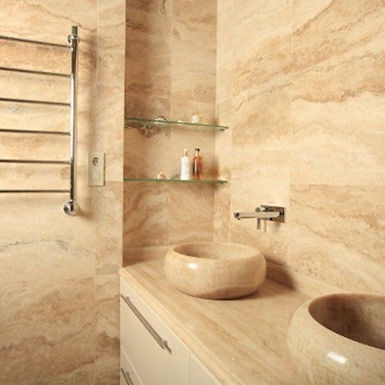
Surface finish as a defining factor
The finish of travertine plays a central role in how bathroom and kitchen surfaces are perceived. In interior environments, finishes tend to be more controlled and refined, allowing the material to interact with light in a softer and more uniform way. Roman travertine stone can be honed, brushed or lightly textured, depending on the desired balance between smoothness and material expression.
Honed and refined surfaces
Honed travertine is one of the most common finishes for interior surfaces, as it creates a smooth, matte appearance that enhances the natural color of the stone without excessive reflection. This type of finish supports a clean and architectural look, making it suitable for countertops and wall surfaces where visual calmness is essential. Roman travertine in this finish maintains its identity while adapting to modern interior design language.
Material perception at close range
Because interior surfaces are observed closely, even small variations in finish and texture become significant. Roman travertine allows designers to control this perception carefully, ensuring that the surface remains visually consistent while still expressing its natural origin. This level of control is essential in bathrooms and kitchens, where material quality is directly experienced.
Countertops, Washbasins and Integrated Elements

Integrated design solutions
Travertine is often used to create integrated elements such as countertops and washbasins, where the material forms a continuous surface without visible interruptions. Roman travertine stone is particularly suitable for this approach because it can be cut and shaped with precision, allowing the creation of seamless forms that enhance the clarity of the design.
From functional element to design feature
In bathroom and kitchen environments, surfaces are not only functional but also central to the design. Roman travertine countertops and sinks become focal points that define the character of the space. Their natural texture and subtle variation provide visual interest without the need for additional decorative elements.
Consistency with surrounding surfaces
Integrated elements must relate to surrounding walls and floors. Roman travertine allows this connection to be achieved easily, creating a consistent material language across all surfaces. This continuity reinforces the perception of the space as a unified architectural composition.
Travertine in Kitchen and Bathroom Environments

Kitchen surfaces and spatial definition
In kitchens, travertine surfaces contribute to the definition of the space by creating strong horizontal and vertical planes. Roman travertine stone can be used for countertops, backsplashes and wall cladding, establishing a consistent visual framework that organizes the environment. This approach allows the kitchen to be perceived as an architectural space rather than a purely functional area.
Bathroom surfaces and material identity
In bathrooms, travertine enhances the sense of continuity and calmness. The material’s natural tones and textures create a balanced environment, where surfaces are visually connected and free from excessive contrast. Roman travertine stone supports this effect by maintaining consistency across different elements, from sinks to walls.
Adaptability across design styles
Roman travertine adapts to different interior styles, from minimal contemporary spaces to more traditional environments. Its flexibility in terms of finish, format and composition allows it to respond to various design intentions while preserving its natural identity.
Bathroom and Kitchen Surfaces Within the Roman Travertine System
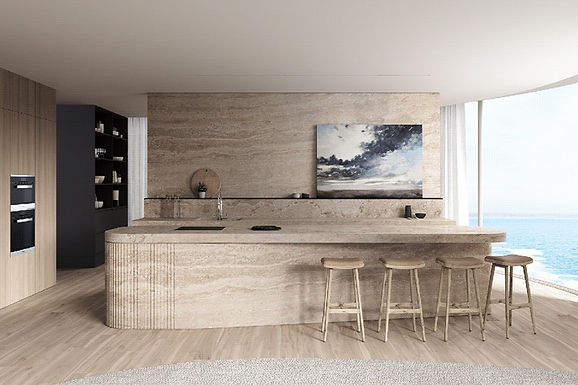
Part of a broader architectural system
Bathroom and kitchen surfaces should be understood as part of a larger Roman Travertine system, where different applications are connected through a shared material language. These surfaces relate directly to travertine flooring and travertine wall cladding, ensuring continuity across interior spaces.
Connecting horizontal and vertical planes
Roman travertine stone allows horizontal surfaces such as countertops to connect seamlessly with vertical elements like walls. This integration creates a cohesive architectural environment where materials do not appear fragmented but unified.
From interior surface to architectural identity
Through Roman travertine, even functional surfaces contribute to the overall identity of the project. Bathroom and kitchen elements become part of a consistent design language that extends across the entire space, reinforcing both visual coherence and material depth.
Bathroom and Kitchen Surfaces FAQ
1. What are travertine bathroom and kitchen surfaces?
Travertine bathroom and kitchen surfaces include countertops, sinks, wall cladding, backsplashes and integrated architectural elements made from natural stone. In these spaces, Roman travertine is used not simply as a decorative covering, but as a material capable of shaping the identity of the interior through continuity, texture and architectural coherence. Because the same stone can be used across horizontal and vertical planes, it helps create spaces that feel unified rather than fragmented into different finishes. This makes travertine especially suitable for bathrooms and kitchens where visual calmness, material depth and a strong sense of design continuity are important.
2. Is Roman travertine suitable for interior surfaces?
Yes, Roman travertine is widely used for interior applications because it combines durability with a refined and natural appearance. Its surface offers a balance between geological texture and architectural clarity, making it suitable for environments where the material is seen at close range and directly experienced. In bathrooms and kitchens, Roman travertine can contribute warmth, depth and consistency without becoming visually excessive. It is particularly effective in interiors that aim to combine natural stone character with clean architectural composition, allowing surfaces to feel both substantial and carefully designed.
3. What finishes are used for these surfaces?
Common finishes for travertine bathroom and kitchen surfaces include honed and brushed treatments, both of which create a controlled and refined appearance suitable for interiors. Honed travertine usually provides a smoother and more even surface, enhancing the natural color of the stone while keeping reflections soft and restrained. Brushed finishes, by contrast, preserve slightly more texture and tactile depth, making the surface feel more materially expressive. The choice of finish depends on the intended architectural language, but in all cases Roman travertine allows interior surfaces to remain visually calm while still expressing the natural qualities of the stone.
4. Can travertine be used for countertops?
Yes, Roman travertine is often used for countertops because of its structural consistency and its ability to be processed into precise and well-defined forms. As a countertop material, it offers not only functional performance but also strong visual presence, especially when integrated with matching walls, sinks or surrounding surfaces. Travertine countertops can help establish a coherent design language in kitchens and bathrooms, where the material becomes part of the architecture rather than just an applied surface. This makes Roman travertine a suitable choice when the goal is to create an interior with continuity and natural material depth.
5. Are integrated sinks possible in travertine?
Yes, travertine can be used to create integrated sinks and basins, allowing the surface and the functional element to read as one continuous architectural piece. This approach is especially effective in bathrooms, where Roman travertine can form countertops, washbasins and wall surfaces within the same material logic. Integrated solutions reduce visual interruption and strengthen the sense of coherence within the space. Because Roman travertine can be shaped with precision, it supports clean geometries while still preserving the natural depth and texture that distinguish it from more artificial or industrial surface materials.
6. Does travertine work in kitchens?
Yes, Roman travertine works well in kitchens, where it is used for countertops, backsplashes, wall surfaces and other integrated elements. In this context, the material contributes not only functionally but also architecturally, helping define the kitchen as a coherent interior space rather than a collection of independent components. Its natural tones and layered texture allow it to pair well with cabinetry, wood, metal and other finishes, while still maintaining a clear identity of its own. Roman travertine is especially effective in kitchens designed around continuity, restraint and the use of durable natural materials.
7. How does travertine interact with light indoors?
Roman travertine interacts with indoor light in a soft and balanced way, which is one of the reasons it is so effective in interior architecture. Rather than producing sharp reflections, the stone tends to diffuse light gently across its surface, making its tonal variation and subtle texture more visible. This enhances the perception of depth and gives the material a calm but rich presence in the room. In bathrooms and kitchens, where lighting often plays a major role in how surfaces are perceived, Roman travertine helps create an atmosphere that feels both natural and architecturally composed.
8. Can it be combined with other materials?
Yes, Roman travertine can be combined with other materials, including wood, metal, glass and painted surfaces, and it often works particularly well in interiors where contrasts are carefully controlled. Even so, it is frequently used as the primary material when the objective is to maintain continuity across floors, walls and integrated elements. This approach allows the space to feel more unified and less fragmented. When used together with other finishes, Roman travertine still tends to act as the visual anchor of the composition, helping organize the interior around a stable and coherent material language.
9. Is it suitable for modern interiors?
Yes, Roman travertine adapts very well to modern interiors, especially when used in controlled formats, precise geometries and refined finishes such as honed surfaces. Its natural texture prevents minimalist spaces from feeling cold or artificial, while its visual consistency allows it to work within clean architectural compositions. In bathrooms and kitchens, this balance is particularly valuable because the material can provide warmth and depth without compromising the clarity of the design. Roman travertine is therefore fully compatible with contemporary architecture, not despite its natural origin, but because of it.
10. Why choose Roman travertine for interior surfaces?
Roman travertine is chosen for interior surfaces because it combines durability, natural beauty and architectural versatility in a single material. It allows bathrooms and kitchens to be designed as coherent spaces where countertops, walls, basins and other elements share the same material language. Its tonal softness, layered structure and refined finishes make it suitable for interiors that seek both visual calmness and material depth. Choosing Roman travertine means using a natural stone that can move beyond decoration and become an integral part of the interior architecture, shaping the identity of the space in a lasting way.
Roman Travertine Bathroom and Kitchen Surfaces
A refined interior application of Roman Travertine
Bathroom and kitchen surfaces represent a refined application of Roman Travertine stone, where material, design and functionality converge in a controlled and coherent architectural system. In these environments, surfaces are not treated as isolated elements, but as part of a broader spatial composition where continuity and proportion play a central role. Roman travertine allows this approach by offering a material that is both structurally reliable and visually balanced. To better understand the origin and characteristics of the material, it is useful to refer to the main guide on Roman Travertine, where its geological formation, structural properties and architectural relevance are explored in depth, providing a complete framework for its application in both interior and exterior contexts.
Part of a wider architectural system
These surfaces are closely connected to applications such as travertine flooring and travertine wall cladding, forming a unified interior system where horizontal and vertical planes are integrated through a consistent material language. Roman travertine allows different elements to be coordinated without visual fragmentation, creating spaces that feel intentional and architecturally resolved. This continuity extends beyond simple material repetition, influencing how the space is perceived, organized and experienced. By connecting surfaces, edges and volumes, Roman travertine contributes to a design logic that prioritizes clarity, balance and long-term coherence.
From surface to architectural identity
Through Roman travertine, interior surfaces become more than functional components, contributing directly to the identity and atmosphere of the architectural space. Countertops, walls and integrated elements are perceived as part of a single material system rather than separate interventions, reinforcing the unity of the design. This approach allows the material to define the character of the environment, where texture, tone and structure work together to create a coherent and refined interior language. In this sense, Roman travertine does not simply cover surfaces, but shapes the architectural identity of the space, connecting function, material and design into a consistent and lasting composition.