
Honed Open Pore Travertine Stone: Natural Finish with Visible Pores and Authentic Texture
Honed open pore travertine stone is one of the most natural finishes used in Roman Travertine, preserving the original structure of the stone while refining its surface. Unlike filled travertine stone, where pores are sealed, this finish keeps the natural holes visible, maintaining the authentic character of the material.
The honing process smooths the surface of the travertine stone without closing the pores, creating a balanced result between refinement and raw texture. This makes honed open pore travertine stone particularly suitable for architectural projects where material honesty and tactile quality are essential.
Widely used in flooring, wall cladding and outdoor applications, this natural stone finish offers a unique combination of visual depth, natural irregularity and long-term performance. It is especially appreciated in contemporary architecture, where the goal is to highlight the true nature of the stone rather than conceal it.

What is Honed Open Pore Travertine Stone?

Honed open pore travertine stone is a surface finish that preserves the natural pores of the material while refining its surface through a honing process. This treatment enhances the stone without altering its original structure, allowing the characteristic cavities to remain visible.
Unlike filled travertine stone, where pores are sealed with cement or resin, the open pore finish maintains the material in a more natural state. The result is a surface that reflects the geological formation of the stone, combining a smoother touch with a visibly authentic texture.
How the Honed Open Pore Travertine Stone Finish is Created
-
The surface of the travertine stone is honed using abrasive processes that smooth and refine the material while preserving its natural composition.
-
Unlike filled finishes, the pores and cavities are intentionally left open, maintaining the original structure of the stone.
-
No cement or resin is applied, allowing the travertine stone to retain its natural porosity.
-
The visible pores become an integral part of the surface, emphasizing the material’s geological origin.
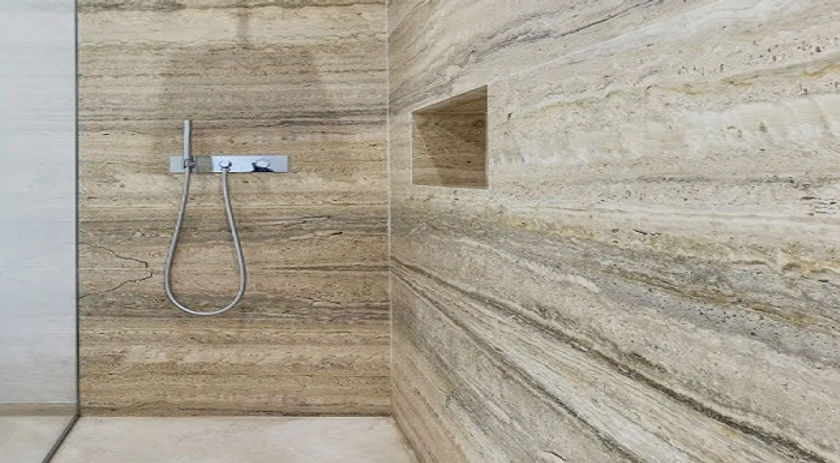
Aesthetic Characteristics of Honed Open Pore Travertine Stone
The honed open pore travertine stone finish is appreciated for its ability to express the natural character of the material while maintaining a controlled and refined surface. The visible pores contribute to a textured appearance that reflects the geological formation of the stone, creating depth and variation across the surface.
The honing process softens the surface without eliminating its irregularities, resulting in a balance between smoothness and natural texture. This combination allows the travertine stone to interact with light in a subtle way, enhancing its tonal variations and layered structure.
-
The open pores create a surface that emphasizes the natural formation of the travertine stone.
-
The honed finish produces a smoother tactile quality while maintaining visual irregularity.
-
Natural tonal variations and stratification become more evident under changing light conditions.
-
The finish supports both contemporary and traditional architectural contexts without altering the material’s identity.
Where Honed Open Pore Travertine Stone is Used
Due to its balance between refinement and natural texture, honed open pore travertine stone is used in a wide range of architectural applications. Its surface allows for both visual continuity and material expression, making it suitable for projects where the authenticity of natural stone is a defining element.
Interiors
-
Flooring surfaces where a natural yet controlled texture is required.
-
Wall cladding in bathrooms and living spaces, enhancing material depth.
-
Architectural details where the stone surface remains visually expressive.
Exteriors
-
Facades where natural stone texture contributes to the architectural identity.
-
Outdoor paving in low-traffic areas where the open pore surface is preserved.
-
Landscape elements where the material integrates with natural surroundings.

Architectural Considerations of Honed Open Pore Travertine Stone
The choice of honed open pore travertine stone in architectural design is often related to the intention of preserving the material’s natural identity. Unlike filled finishes, this surface allows the stone to remain visually connected to its geological origin, making it suitable for projects where authenticity is a central design principle.
The presence of open pores introduces a level of visual depth and irregularity that cannot be replicated by more processed finishes. This characteristic is particularly relevant in spaces where the material is meant to be perceived as a natural element rather than a uniform surface.
-
The open pore structure emphasizes the natural formation of the travertine stone.
-
The honed surface provides a refined finish without eliminating material irregularities.
-
The interaction with light enhances tonal variation and surface depth.
-
The finish supports architectural approaches that prioritize material authenticity.
Typical Dimensions and Thickness of Travertine Stone Elements
Travertine stone used in honed open pore finishes is produced in a range of dimensions and thicknesses depending on its intended application. The selection of size is not only a technical decision, but also an architectural one, influencing the perception of joints, continuity and surface rhythm.
Larger formats tend to emphasize the continuity of the stone surface, while smaller modules highlight its natural variation. Thickness is selected according to structural and functional requirements, particularly in flooring and outdoor applications.
-
Medium thickness elements are commonly used for flooring applications.
-
Thinner sections are applied in wall cladding and vertical surfaces.
-
Increased thickness is required for outdoor use and load-bearing contexts.
-
Format selection influences both technical performance and visual outcome.

Open Pore vs Filled Travertine Stone
The difference between honed open pore travertine stone and filled travertine stone lies in how the natural cavities of the material are treated. As part of the broader category of Roman Travertine stone, this distinction reflects different approaches to preserving or modifying the natural structure of the material. In open pore finishes, the surface retains its original porosity, leaving the natural voids visible and preserving the geological character of the stone.
In filled travertine stone, these cavities are sealed using cement or resin, creating a more uniform and continuous surface. This process reduces visual irregularities and produces a smoother appearance, but partially alters the natural expression of the material.
From an architectural perspective, the choice between open pore and filled travertine stone is not only aesthetic but conceptual. Open pore finishes emphasize material authenticity and natural formation, while filled surfaces offer a more controlled and homogeneous visual result.
Types of Roman Travertine
Roman Travertine is extracted in different varieties, each defined by specific tones, textures and structural characteristics developed during its geological formation.
Among the most recognized types is Travertino Classico, known for its warm and balanced appearance and its long-standing use in architecture. Alongside it, Travertino Silver offers cooler tones and a more contemporary character, while Travertino Noce is distinguished by deeper and darker shades that create a stronger visual impact.
Travertino Navona represents a lighter and more refined variation, often selected for projects where elegance and subtle surface variations are required.
Each of these types belongs to the broader family of Roman Travertine and can be used in a wide range of architectural applications depending on the design intent and material selection.


Roman Travertine Finishes: Natural textures for different architectural styles
Roman Travertine is appreciated not only for its natural origin but also for the variety of finishes that can be applied to the stone.
Different surface treatments allow architects and designers to adapt the material to different architectural styles and project requirements.
From smooth finishes to more textured surfaces, each treatment highlights specific characteristics of the stone, enhancing its natural structure, color variations and tactile qualities.
These finishes can be used for both interior and exterior applications, including floors, wall cladding, stairs, terraces and architectural details.
Below are some of the most common finishes used for Roman Travertine in residential and architectural projects.

Filled and Honed

Honed – Open Pore

Filled and Brushed

Brushed – Open Pore

Antique Finish

Natural Split
Roman Travertine in architectural products
Below you can explore a small selection of Roman Travertine products and worked elements used in architectural and residential projects.
This section is intended as an overview of how the stone can be prepared for different uses, from flooring and wall cladding to coping stones, steps and custom elements.


Product categories and stoneworking services in Roman Travertine
Roman Travertine can be supplied in a wide range of products and worked elements for architectural and residential projects.
Our selection includes materials for flooring, wall cladding, bathroom and kitchen coverings, coping stones, stairs, window sills, skirting boards, furnishings and decorative elements.
We also provide stoneworking services for selected applications, with solutions prepared according to the requirements of each project.
Below you can explore some of the main product and service categories available in Roman Travertine.

Flooring

Walls

Bathroom and Kitchen Cladding

Coping stones

Skirting boards

Stone Furnishings

Floor polishing

Marble and travertine engraving

Stairs

Palladiana flooring

Thresholds

Window sills
Travertine Blog and Architectural Insights
Explore the architectural use of Roman Travertine through projects, material insights and technical considerations. This section presents real applications, surface finishes and construction details, offering a deeper understanding of how travertine is used in different contexts.
From historical architecture to contemporary design, each article highlights how this natural stone performs in practice, focusing on material characteristics, surface treatments and architectural solutions.
The blog provides a structured view of Roman Travertine as a building material, supporting both design inspiration and technical understanding.


