
Roman Travertine Stone Flooring
Roman travertine flooring for interior and exterior architectural surfaces.

Travertine flooring is one of the most direct applications of Roman travertine stone in architecture, where the material defines not only the surface of a space but also its overall perception. As a natural stone, travertine expresses its identity through structure, porosity and tonal variation, rather than through applied finishes.
In architectural contexts, flooring plays a fundamental role in shaping how space is experienced. Roman travertine stone flooring creates continuous surfaces that influence light, movement and spatial coherence, becoming an active element of the design rather than a neutral background.
Its adaptability allows it to be used across different environments, from residential interiors to large-scale architectural spaces, while maintaining a consistent material language. At the same time, variations in cut, finish and layout determine how the stone behaves visually and functionally within each project.
Understanding travertine flooring therefore means understanding how Roman travertine stone interacts with architecture, through its material properties, surface characteristics and spatial impact.
What Travertine Flooring Means in Architecture

Travertine flooring should be understood not simply as a finishing material, but as a primary architectural surface that defines how a space is experienced. Unlike vertical elements, flooring is continuously perceived through movement, scale and light, making its material qualities immediately relevant to the overall composition.
Travertine flooring as an architectural surface
In Roman travertine stone, these qualities are particularly evident. The natural structure of the material, defined by pores, tonal variation and layered formation, creates a surface that is both consistent and non-uniform. This allows large floor areas to maintain visual coherence without becoming repetitive or artificial.
As a result, travertine flooring establishes a continuous material field that connects different parts of a space. Rather than acting as a neutral base, it becomes an active component of the architectural language, influencing perception, orientation and spatial continuity.
To fully understand this role, it is useful to consider the broader context of Roman Travertine as a natural stone used in architecture, and how it relates to wider travertine architectural applications across different building typologies.
Surface Appearance and Material Structure of Travertine Flooring

Travertine flooring is defined by the intrinsic structure of the stone, which directly influences how the surface appears and behaves within a space. Unlike manufactured materials, Roman travertine stone is characterized by a naturally porous composition, with visible cavities, tonal variation and layered formation that remain evident across the surface.
Natural structure and surface variation
These characteristics create a flooring surface that is both consistent and irregular at the same time. The distribution of pores and variations in tone do not follow a repetitive pattern, allowing the floor to maintain a natural appearance even across large areas. This irregularity is not a defect, but a defining quality of travertine stone, contributing to its architectural value.
Visual continuity and spatial perception
When applied as flooring, this material structure influences how space is perceived. The surface interacts with light in a non-uniform way, creating subtle variations that enhance depth and continuity. Instead of producing a flat or artificial effect, travertine flooring establishes a visual rhythm that connects different areas of a space, reinforcing spatial coherence.
Cut Orientation and Visual Structure of Travertine Flooring
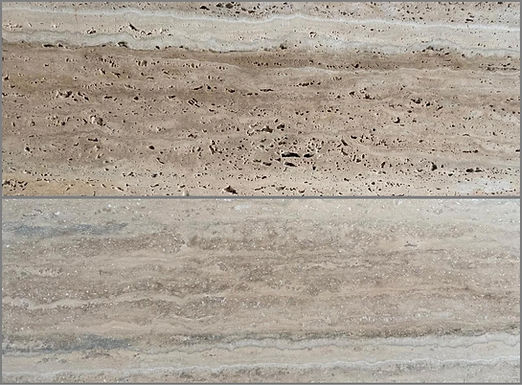
The appearance of travertine flooring is strongly influenced by the way the stone is cut, as this determines how its internal structure becomes visible on the surface. Roman travertine stone can be processed in different orientations, and this choice directly affects the visual behavior of the flooring within a space.
Vein cut travertine flooring
In vein cut travertine flooring, the stone is cut along its natural layers, producing a surface characterized by linear patterns and continuous horizontal veins. This orientation emphasizes the stratified formation of the material, creating a more directional and ordered visual effect. In architectural spaces, vein cut flooring can be used to reinforce geometry, guide movement or align with structural elements.
Cross cut travertine flooring
In cross cut travertine flooring, the stone is cut perpendicular to its natural layers, resulting in a more irregular and cloud-like surface. The distribution of pores and tonal variation appears softer and less directional, creating a more uniform visual field. This type of surface is often preferred in spaces where the flooring must feel continuous without introducing strong directional lines.
Where Travertine Flooring Is Used in Architecture

Travertine flooring is used across a wide range of architectural contexts, from private residential interiors to large-scale public and commercial environments. Its adaptability allows it to function both as a neutral base material and as a defining element of spatial identity, depending on how it is integrated within the design.
Interior architectural applications
In interior architecture, Roman travertine stone flooring is commonly used in living areas, kitchens and open-plan spaces where continuity between rooms is essential. The material creates a unified surface that enhances natural light and establishes a consistent visual language throughout the interior. Its natural tones and subtle variation allow it to work effectively in both contemporary and more traditional architectural settings.
Exterior and transitional spaces
Travertine flooring is also widely used in semi-exterior and outdoor architectural environments, such as covered terraces, courtyards and transitional areas between interior and exterior spaces. In these contexts, the choice of finish becomes particularly important, as more textured surfaces improve grip and functional performance while maintaining visual continuity with interior flooring.
Durability and long-term use

Travertine flooring performs reliably over time when the material is properly selected and installed, making it suitable for both residential and architectural applications. Roman travertine stone has been used for centuries in flooring precisely because it maintains structural integrity under continuous use, while preserving its natural surface characteristics.
Durability and long-term use
In interior environments, travertine flooring offers a stable and durable surface that resists everyday wear without losing its visual identity. Unlike artificial materials that degrade uniformly, natural stone evolves over time, developing a patina that reflects use rather than masking it. This makes Roman travertine flooring particularly suitable for spaces where longevity and material authenticity are essential.
Surface behaviour in different conditions
In exterior and transitional spaces, travertine flooring is exposed to changing environmental conditions such as moisture, temperature variation and surface wear. The material responds naturally to these conditions, with water interacting with the surface and temporarily enhancing its tonal variation, as seen in wet environments. In colder climates, exposure to snow and temperature changes highlights the importance of proper installation and surface selection, ensuring both durability and functional performance.
Travertine Flooring FAQ
1. Is travertine flooring suitable for outdoor use?
Travertine flooring is suitable for outdoor use when the correct surface finish and installation method are applied. Its natural structure allows it to perform well in exterior environments, particularly in Mediterranean climates. In exposed areas, textured finishes improve grip, while proper installation ensures long-term durability.
2. Does travertine flooring become slippery when wet?
Travertine flooring can become more or less slippery depending on the surface finish. Smooth finishes such as honed surfaces tend to be more slippery, while brushed or textured finishes provide better grip. In outdoor or wet areas, selecting the right finish is essential for safe use.
3. Is Roman travertine flooring durable over time?
Roman travertine flooring is highly durable and has been used in architecture for centuries. When properly installed and maintained, it resists wear and maintains its structural integrity. Over time, it develops a natural patina that enhances its character rather than degrading its appearance.
4. What is the difference between vein cut and cross cut travertine flooring?
Vein cut travertine flooring shows linear patterns that follow the natural layers of the stone, creating a more directional appearance. Cross cut travertine has a more irregular and cloud-like pattern. The choice depends on the visual effect desired within the architectural space.
5. Does travertine flooring require sealing?
Travertine flooring generally benefits from sealing, especially in areas exposed to moisture or frequent use. Sealing helps reduce absorption and protects the surface from stains, while preserving the natural look of the stone.
6. Is travertine flooring suitable for modern architecture?
Travertine flooring is widely used in modern architecture due to its neutral tones and natural texture. It creates continuous surfaces that work well in open-plan spaces, supporting a clean and coherent architectural language.
7. How does travertine flooring behave in different climates?
Travertine flooring adapts well to different climates, but its performance depends on correct installation and surface treatment. In warm climates it remains comfortable underfoot, while in colder environments it can withstand temperature changes when properly installed.
8. Can travertine flooring be used around pools?
Travertine flooring is commonly used around pools because of its natural appearance and performance. Textured finishes improve grip in wet conditions, and the material remains relatively comfortable under sunlight compared to darker surfaces.
9. Does travertine flooring change over time?
Travertine flooring may show slight changes over time due to use, light exposure and environmental conditions. These changes are usually subtle and contribute to the natural aging of the material, enhancing its authenticity.
10. Is travertine flooring easy to maintain?
Travertine flooring is relatively easy to maintain with regular cleaning and occasional sealing. Using appropriate products helps preserve the surface while maintaining its natural characteristics over time.
Roman Travertine Flooring in Architecture
Travertine flooring represents one of the most complete expressions of Roman travertine stone within architecture, where material, surface and spatial continuity converge into a single architectural element. More than a simple finishing layer, it defines how space is perceived and experienced over time.
Material continuity and architectural space
As a continuous surface, Roman travertine stone flooring establishes a direct relationship between different areas of a space, guiding movement and reinforcing spatial coherence. Its natural structure interacts with light in a subtle and non-uniform way, creating depth without relying on artificial patterns or repetitive textures. This allows the material to remain visually consistent while preserving its natural variability.
Surface, use and long-term performance
The relevance of travertine flooring extends beyond its appearance, involving how the material responds to real conditions of use. From interior environments to exterior terraces and transitional spaces, its performance depends on the relationship between cut, finish and installation. Over time, the surface evolves naturally, developing a patina that reflects use and enhances the authenticity of the material, reinforcing its role as both a functional surface and an architectural component.