
Travertine Paving in Roman Travertine Stone
Roman Travertine paving for outdoor architectural surfaces and landscape continuity.
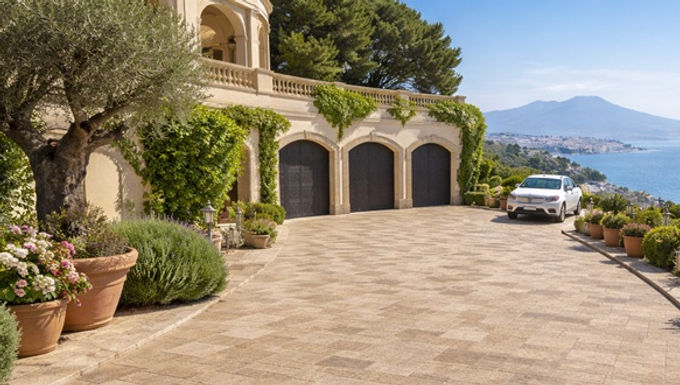
Travertine paving is one of the most established ways in which Roman Travertine natural stone is used in architecture, especially in outdoor spaces where material continuity, durability and surface character matter at the same time. As a natural stone, Roman travertine brings together structural performance and visual depth, making paving not only a functional layer for circulation but also an architectural element that defines the atmosphere of terraces, courtyards, garden paths and open-air living areas.
In paving applications, the stone is read through scale, finish, porosity and laying pattern. These factors influence how the surface reacts to light, how it feels underfoot and how it integrates with walls, steps, pools and landscape features. Roman travertine paving can therefore appear rigorous and minimal in contemporary projects or warmer and more textured in traditional settings, depending on the finish and format selected.
Because paving is exposed to weather, use and seasonal variation, understanding the relationship between stone structure and outdoor performance is essential. This page explores how Roman travertine paving is used in architecture, which finishes and cuts are most suitable, how paving formats shape space, and why this natural stone remains relevant in both residential and public exterior design.
Why Travertine Paving Works in Outdoor Architecture

Paving as an architectural surface
Travertine paving is not simply an exterior flooring solution but a true architectural surface that organizes movement, proportion and visual continuity in outdoor design. In courtyards, terraces and open transitional spaces, Roman travertine stone gives the ground a material identity that connects horizontal surfaces to the broader architectural language of the project. Because the stone has a clear geological structure and a naturally soft range of tones, it creates surfaces that feel substantial without becoming visually heavy.
Material continuity and spatial coherence
One of the main strengths of Roman travertine paving is its ability to unify exterior areas through a coherent stone surface. It can extend from internal thresholds toward outdoor patios, garden paths or porticoes, helping architecture and landscape read as part of the same composition. This continuity becomes even more effective when paving is coordinated with wall cladding, stairs or coping details in the same travertine family. The result is not only aesthetic consistency but also a stronger perception of spatial order.
Balance between texture and geometry
Travertine paving works well outdoors because it balances natural texture with geometric clarity. The stone retains the irregular depth and porosity that characterize a natural material, yet it can be cut into precise modules that support clean architectural layouts. This combination allows Roman travertine stone paving to suit both restrained contemporary projects and more traditional environments, adapting through finish, format and joint design rather than changing the material itself.
Finishes and Surface Qualities for Travertine Paving

Surface finish and outdoor perception
In travertine paving, the finish determines how the stone is perceived both visually and physically. It affects light reflection, tactile response, pore visibility and the overall character of the paved surface. Roman travertine stone can therefore appear more refined, more rustic or more expressive depending on whether the paving is specified with a brushed, honed, antique or open pore finish. Choosing the finish is not a secondary detail but part of the architectural definition of the space.
Brushed, antique and open pore solutions
For exterior paving, textured finishes are often preferred because they reinforce the natural presence of the stone and reduce the overly smooth appearance that may feel disconnected from outdoor settings. Brushed travertine paving reveals a soft relief across the surface, while antique finishes introduce a more time-worn and irregular character suitable for courtyards, gardens and traditional compositions. Open pore solutions preserve the readable structure of the travertine, allowing the stone to communicate its geological origin more directly.
How finish changes the design language
The same Roman travertine paving slab can contribute to very different architectural results depending on surface treatment. A more regular and subdued finish supports contemporary landscape design and precise geometric layouts, while a more tactile finish strengthens the relationship between the paving and the natural environment. For this reason, finish selection should always be considered together with format, edge treatment and the surrounding architectural elements rather than as an isolated aesthetic choice.
Formats, Layouts and Design Logic in Travertine Paving

Format as a spatial tool
In travertine paving, the size and proportion of the stone modules influence how outdoor space is read. Larger slabs tend to emphasize continuity and calm visual rhythm, making terraces and wider paved areas appear more open and controlled. Smaller modules or mixed formats can instead create a more articulated and dynamic surface, especially in garden paths, inner courtyards or projects that seek a stronger relationship with traditional stone construction. Roman travertine stone responds well to both approaches because its texture remains legible across different scales.
Regular grids and mixed compositions
A regular paving grid gives Roman travertine a measured architectural presence, especially when the design aims for contemporary clarity. This solution highlights alignment, joint rhythm and dimensional precision. Mixed layouts, on the other hand, can introduce a more layered reading of the surface, breaking repetition and making the paving feel more rooted in historic or landscape-based contexts. In both cases, travertine paving is effective because the stone carries enough natural variation to avoid monotony without compromising overall order.
Relationship with adjacent elements
Travertine paving should never be designed in isolation. Its format must relate to thresholds, steps, wall bases, drainage lines and the geometry of the surrounding architecture. When the paving logic is coherent, the exterior surface becomes part of a larger stone system rather than a separate decorative layer. This is one of the reasons Roman travertine paving remains so valuable in architecture: it can structure the outdoor ground plane while staying fully integrated with the building and its landscape context.
Roman Travertine Paving in Courtyards, Terraces and Paths

Courtyards and open-air living spaces
Travertine paving is particularly suited to courtyards because it creates a durable and visually calm stone surface that supports both circulation and permanence. In these spaces, Roman travertine stone contributes to the architectural atmosphere by reflecting light softly and by establishing a continuous material field that enhances walls, porticoes, planted areas and outdoor furnishings. The paving becomes the base layer through which the courtyard gains coherence and architectural weight.
Terraces and transitional surfaces
On terraces, travertine paving performs an important transitional role between interior architecture and the open exterior environment. The stone can extend the language of indoor flooring outward while adapting to the environmental exposure of an outdoor surface. This makes Roman travertine paving especially relevant in projects where continuity between house and landscape is central. Its natural tone range helps connect built form, sky and vegetation without introducing abrupt material contrast.
Paths, gardens and landscape integration
In garden paths and landscape routes, travertine paving can either define movement precisely or accompany it more softly, depending on format and layout. The stone works well in these applications because it does not feel artificial against natural surroundings. Instead, it introduces order while still preserving a sense of material authenticity. For this reason, Roman travertine stone paving is used not only in formal architectural spaces but also in transitional zones where landscape and built environment need to remain visually connected.
Travertine Paving as Part of a Complete Stone System

Beyond paving alone
Travertine paving becomes more effective when it is considered as part of a complete stone system rather than a single isolated application. In architectural projects, exterior paving often relates directly to stairs, pool edges, coping elements, thresholds, wall bases and cladding surfaces. When these parts are coordinated in Roman travertine stone, the project gains visual continuity and material coherence, while the outdoor environment feels intentionally designed rather than assembled through separate solutions.
Connection with other travertine applications
A paved surface can lead naturally toward travertine wall cladding, align with stone flooring at a threshold, or connect with coping stones around water features and raised edges. This relationship matters because it allows the paving to function as the horizontal foundation of a larger architectural composition. Roman travertine paving is especially strong in this role because its surface character is compatible with multiple finishes and details without losing identity. The same material language can therefore extend across several parts of the project.
A bridge between architecture and product
From an editorial and design perspective, travertine paving also acts as a bridge between material knowledge and practical stone selection. Understanding paving means understanding thickness, finish, module and coordination with other elements. That is why this application page should connect not only to broader guides on Roman Travertine, finishes and architectural uses, but also to related stone products such as paving slabs and traditional outdoor formats, including solutions connected to palladiana and other paving-oriented product systems.
Roman Travertine Paving FAQ
1. What is travertine paving?
Travertine paving is the use of travertine stone as an exterior surface for terraces, courtyards, garden paths and other outdoor architectural areas. In the case of Roman Travertine, the paving is defined by a natural limestone structure with visible porosity, layered formation and tonal variation. It is valued not only for resistance and durability, but also for the way it gives outdoor space a coherent architectural surface rather than a purely technical flooring layer.
2. Is Roman travertine suitable for outdoor paving?
Yes, Roman travertine is widely used for outdoor paving because it combines structural solidity with a surface character that works well in exterior architecture. Its suitability depends on correct specification, including finish, thickness, module and installation logic. In courtyards, terraces and paths, Roman travertine paving is appreciated because it creates a natural stone surface that remains visually stable and materially expressive under changing light and weather conditions.
3. Which finish is best for travertine paving?
There is no single finish that is best in every case, because the right choice depends on the architectural language of the project. Brushed, antique and open pore finishes are often preferred for outdoor travertine paving because they preserve surface texture and reinforce the natural identity of the stone. More regular finishes can also be used when the design requires a cleaner and more controlled appearance. The finish should always be evaluated together with the intended context and surrounding elements.
4. Where can travertine paving be used?
Travertine paving can be used in terraces, courtyards, garden paths, porticoes, entrance areas, patios and many other exterior architectural spaces. It is especially effective where the project benefits from a strong visual link between building and landscape. Roman travertine stone paving is not limited to residential use: it can also define public and semi-public spaces where a durable and visually coherent natural stone surface is required.
5. Does travertine paving look too rustic for contemporary architecture?
No, not necessarily. Travertine paving can appear very contemporary when it is specified with the right slab proportions, joint rhythm and finish. Roman travertine stone has enough natural texture to remain expressive, but it can also be cut and laid with great geometric precision. This allows it to suit minimalist and contemporary architecture just as effectively as more traditional or historically rooted projects. The final result depends on design choices, not on the material alone.
6. What is the difference between travertine paving and travertine flooring?
The two applications are related, but they are not identical. Travertine flooring usually refers more often to interior or transitional surfaces, while travertine paving is typically associated with outdoor architectural use. Paving must be considered in relation to weather exposure, landscape context and exterior circulation. Roman travertine works in both cases, but the specification logic changes depending on whether the stone is used inside, outside or across both environments in continuity.
7. Can travertine paving be combined with wall cladding and steps?
Yes, and this is one of its main strengths. Travertine paving often becomes more effective when it is coordinated with wall cladding, stair treads, coping stones, thresholds and other architectural details in the same material family. Roman travertine stone allows these combinations because it offers consistency across multiple applications while still preserving the natural variation that gives the project depth. This makes paving part of a complete architectural stone system rather than a standalone surface.
8. Do large-format slabs work well for travertine paving?
Large-format slabs can work very well for travertine paving when the design aims for visual continuity and calm geometric order. They tend to reduce the apparent fragmentation of the surface and can make outdoor spaces feel broader and more unified. At the same time, smaller formats or mixed layouts may be better suited to projects that seek a more articulated or traditional expression. Roman travertine stone supports both approaches because its character remains readable across scale.
9. Is travertine paving only for classic-style projects?
No. Although travertine has a long architectural history, its use in paving is not limited to classical or traditional settings. Roman travertine paving is equally relevant in contemporary architecture, especially when combined with controlled proportions, minimal detailing and restrained surface treatments. Its historical depth is part of its appeal, but the material remains current because it can translate into very different spatial languages without losing its stone identity.
10. Why choose Roman travertine for paving instead of another stone?
Roman travertine offers a rare combination of geological identity, architectural tradition and design flexibility. It has enough texture and porosity to feel like a true natural stone, yet it can be integrated into highly ordered architectural compositions. For paving, this means the surface can be durable, visually calm and materially expressive at once. Choosing Roman travertine paving is often less about decoration and more about giving outdoor space a lasting stone structure with real architectural presence.
Explore More Roman Travertine Applications
An application that explains the material
Travertine paving is one of the clearest ways to understand how Roman travertine stone moves from geological material to architectural surface. In outdoor use, the stone is not abstract: it defines how space is crossed, perceived and connected to the landscape. Because paving occupies the ground plane, it has a direct effect on the overall reading of terraces, courtyards and open exterior rooms. Roman travertine gives these spaces both visual calm and material depth, allowing the architecture to feel rooted rather than artificially finished.
A key page within the Applications cluster
Within the broader logic of travertine architectural applications, paving plays a central role because it connects several parallel topics: exterior design, surface finish, layout geometry and product-oriented stone selection. It naturally relates back to Roman Travertine as the main material topic, but it also connects to pages such as travertine flooring, travertine wall cladding and travertine pool surround, where the same stone is studied through different architectural functions. This makes the paving page important not only for users but also for the overall internal linking structure of the site.
From guidance to practical stone selection
As the project grows, this page can also serve as a bridge toward practical solutions linked to outdoor paving products, including Roman Travertine slabs and related product pathways such as palladiana-travertino where appropriate. That bridge should remain secondary to the informational purpose of the page, but it is strategically useful because paving is one of the applications where architectural intent and product selection naturally meet. In this sense, travertine paving is not just a surface category: it is one of the strongest points where material knowledge, design language and real-world stone use come together.