
Travertine Pool Surround in Roman Travertine Stone
Roman travertine pool surround for outdoor architectural surfaces, pool edges and integrated landscape design.
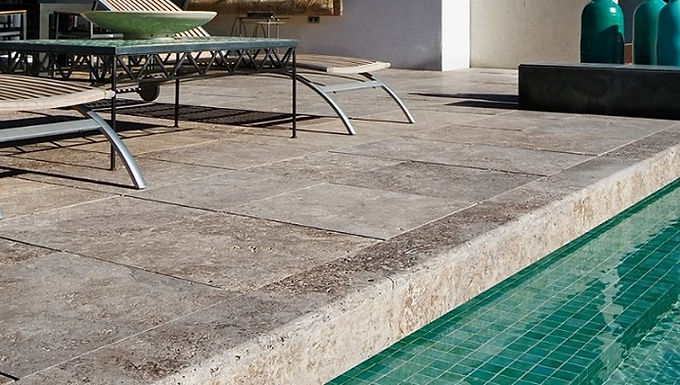
Travertine pool surround is one of the most complete architectural applications of Roman travertine stone, where horizontal surfaces, edges and transitions come together to define the relationship between water, space and material. Unlike a single-function element, the pool surround integrates paving, coping and circulation areas into a unified stone system, creating continuity between the built environment and the outdoor landscape.
In this context, Roman travertine stone is not only selected for its durability, but also for its ability to interact with light, water and surrounding architecture. The natural porosity, tonal variation and layered structure of the material contribute to a surface that remains visually coherent while responding to changing environmental conditions. This makes travertine particularly suitable for pool areas, where reflections, shadows and moisture continuously alter the perception of space.
Because a pool surround is experienced both visually and physically, the design must consider surface finish, module size and spatial continuity. Roman travertine allows these elements to be combined into a single architectural language, connecting the pool edge with surrounding paving and adjacent structures. This page explores how travertine pool surrounds are designed, which finishes and configurations are most effective, and how this application relates to the broader system of Roman Travertine in architecture.
Why Travertine Pool Surround Defines Outdoor Architecture

A unified architectural surface
Travertine pool surround defines outdoor architecture because it combines multiple functional zones into a single, continuous surface. The pool edge, the walking area and the surrounding open space are all integrated through Roman travertine stone, creating a cohesive design rather than a collection of separate elements. This continuity is essential in contemporary architecture, where outdoor spaces are treated as extensions of interior environments rather than independent areas.
Material continuity between water and space
The relationship between water and stone is central to the perception of a pool environment. Roman travertine, with its natural texture and tonal depth, allows this transition to feel balanced and natural. The stone softens the visual boundary between the pool and the surrounding architecture, avoiding harsh contrasts and reinforcing a sense of spatial harmony. This makes travertine pool surrounds particularly effective in projects where integration between landscape and built form is a priority.
An application that structures movement
Beyond aesthetics, travertine pool surrounds organize circulation around the pool. The paving defines paths, resting areas and transitions between zones, guiding movement in a subtle but effective way. Roman travertine stone supports this function by providing a stable and visually legible surface that remains consistent across different parts of the outdoor space.
Surface Finishes and Performance Around Water

Finish as a functional and visual choice
In travertine pool surrounds, surface finish plays a critical role both aesthetically and functionally. The finish determines how the stone interacts with water, light and foot traffic, influencing not only the visual character of the surface but also its usability. Roman travertine stone can be finished in different ways to achieve varying levels of texture and reflectivity, allowing the design to respond to specific architectural requirements.
Textured finishes and material depth
Brushed and open pore finishes are often preferred for pool surrounds because they preserve the natural texture of the stone. These finishes enhance the material’s depth, making the surface more visually engaging while maintaining a strong connection to the geological identity of Roman travertine. The presence of pores and subtle irregularities allows light to interact dynamically with the surface, especially in outdoor conditions where reflections from water play a key role.
Balancing performance and design
The selection of finish must balance performance considerations with the overall design language. A more uniform finish may support a minimal architectural approach, while a more textured surface reinforces the natural character of the environment. Roman travertine pool surrounds are effective because they allow this balance to be achieved without compromising the identity of the material.
Designing Pool Edges, Paving and Spatial Continuity

Integration of coping and paving
A travertine pool surround is not limited to the paving area but includes the design of the pool edge itself. Coping elements define the transition between water and surface, and when coordinated with the surrounding paving in Roman travertine stone, they create a seamless architectural connection. This integration is essential to avoid visual fragmentation and to maintain a consistent material language across the entire pool area.
Module and layout as design tools
The layout of the stone modules influences how the pool surround is perceived. Larger slabs emphasize continuity and openness, while smaller modules or mixed compositions introduce a more articulated and textured surface. Roman travertine adapts well to both approaches, allowing designers to shape the space according to the scale of the project and the desired visual effect.
Continuity with adjacent architecture
The pool surround must relate to the surrounding architecture, including walls, terraces and access points. Roman travertine stone allows these elements to be connected through consistent material use, reinforcing the overall coherence of the project. The result is a space where the pool is not isolated but integrated into a broader architectural composition.
Travertine Pool Surround in Residential and Landscape Design
Residential architecture and outdoor living
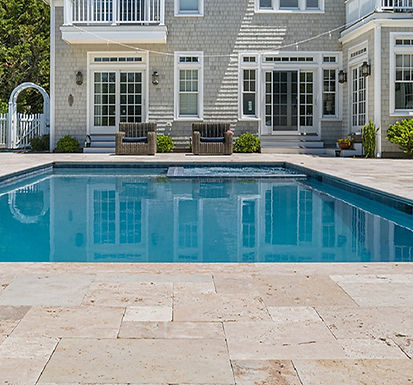
In residential projects, travertine pool surrounds play a central role in defining outdoor living spaces. The area around the pool becomes a place for relaxation, movement and social interaction, and Roman travertine stone provides a stable and visually coherent surface for these activities. Its natural tones integrate easily with vegetation, water and built elements, creating a balanced environment.
Landscape integration and spatial flow
Travertine pool surrounds are often part of a larger landscape design, connecting the pool to gardens, terraces and pathways. Roman travertine allows these transitions to be handled with continuity, avoiding abrupt changes in material and maintaining a consistent visual flow. This makes the pool area feel like an integral part of the landscape rather than an isolated feature.
A material that adapts to different contexts
Whether used in contemporary villas or more traditional settings, Roman travertine pool surrounds adapt to different architectural languages. The flexibility of the material in terms of finish, format and layout ensures that it can respond to a wide range of design intentions while maintaining its identity.
Travertine Pool Surround Within the Roman Travertine System

Part of a broader material system
Travertine pool surround should be understood as part of a complete architectural system rather than a standalone solution. Roman travertine stone is used across multiple applications, including travertine paving and travertine wall cladding, where horizontal and vertical surfaces work together to create a unified design language. This relationship is essential for achieving coherence in complex outdoor environments.
Connection with other architectural elements
The pool surround often interacts with stairs, terraces, walls and other built elements. When these components are designed using Roman travertine, the project gains a strong material identity and a sense of continuity. The stone becomes a common thread that links different parts of the architecture into a cohesive whole.
From application to architectural identity
Seen in this way, travertine pool surround is not only a functional solution but also a key element in defining the architectural character of a space. Through Roman travertine, the material extends across surfaces and elements, reinforcing both the visual and structural identity of the project.
Travertine Pool Surround FAQ
1. What is a travertine pool surround?
A travertine pool surround refers to the stone surfaces that surround a swimming pool, including paving areas, edges and transitions between water and outdoor space. In Roman travertine, this application combines aesthetic continuity with functional performance, creating a unified architectural environment around the pool.
2. Is Roman travertine suitable for pool surrounds?
Yes, Roman travertine is widely used for pool surrounds due to its durability and natural appearance. Its ability to interact with light and water makes it particularly effective in outdoor environments, where visual coherence and material resistance are essential.
3. What finishes are used for pool surrounds?
Travertine pool surrounds are typically finished with textured surfaces such as brushed or open pore treatments. These finishes enhance the natural character of the stone while supporting its use in outdoor environments.
4. What is the difference between pool surround and coping?
Pool coping refers specifically to the edge of the pool, while the pool surround includes the entire area around it, including paving and circulation zones. Roman travertine is often used for both, creating a consistent material connection.
5. Can travertine pool surrounds be used in modern architecture?
Yes, Roman travertine pool surrounds are widely used in contemporary architecture due to their ability to combine natural texture with precise geometric layouts, making them suitable for modern design.
6. How does travertine interact with water and light?
The natural porosity and tonal variation of Roman travertine create dynamic visual effects when exposed to water and light, enhancing the spatial perception of the pool area.
7. Can pool surrounds be integrated with other surfaces?
Yes, travertine pool surrounds can be seamlessly integrated with paving, walls and other architectural elements, creating a continuous material system.
8. Is travertine only for residential pools?
No, Roman travertine pool surrounds can also be used in public and commercial projects, where durability and visual consistency are required.
9. Does travertine require maintenance in pool areas?
Like all natural stone, Roman travertine requires appropriate maintenance to preserve its appearance and performance, especially in environments exposed to water and outdoor conditions.
10. Why choose Roman travertine for pool surrounds?
Roman travertine offers a unique combination of durability, natural beauty and architectural flexibility, making it an ideal material for creating cohesive and long-lasting pool environments.
Roman Travertine Pool Surround and Architectural Continuity
A key application of Roman Travertine
Travertine coping stones represent a refined application of Roman Travertine stone, where precision, durability and architectural clarity come together. To better understand the origin, structure and architectural role of the material, it is useful to refer to the main guide on Roman Travertine, where its geological formation and design potential are explored in depth.
Part of a wider architectural system
This application is closely related to other uses of the material, including travertine flooring and travertine wall cladding, where Roman travertine extends across interior and vertical surfaces. This continuity allows architecture to maintain a consistent material language, reinforcing both visual coherence and spatial identity.
From outdoor surface to design system
Travertine pool surround represents a central application of Roman Travertine stone, where material, space and environmental conditions come together to define outdoor architecture. To better understand the origin, structure and architectural role of the material, it is useful to refer to the main guide on Roman Travertine, where its geological formation and design potential are explored in depth. Through its natural structure and visual depth, the stone creates a continuous surface that connects water, paving and surrounding elements into a unified design.